Showing posts with label CLASS 10. Show all posts

Thursday, September 18, 2025

HEREDITY CLASS 10 WITH NCERT SOLUTIONS.

 Heredity-The transmission of characters from the parents to their off spring is called heredity.The hereditary information is present in the sex cells or in gametes of the parents.

The hereditary information is present in the sex cells (or gametes) of the parents. Thus, gametes constitute the link between one generation and the next, and pass on the paternal [father's] and maternal [mother's] character (or traits) to the offspring.

The relation that continues to exist between successive generations is referred to as Heredity.


HOW TRAITS ARE EXPRESSED?

Traits are coded in the form of genes and genes are the sequences which code for particular polypeptides which lead to the formation of particular proteins. Proteins then lead to the expression of particular traits.

Sex determination in human beings.

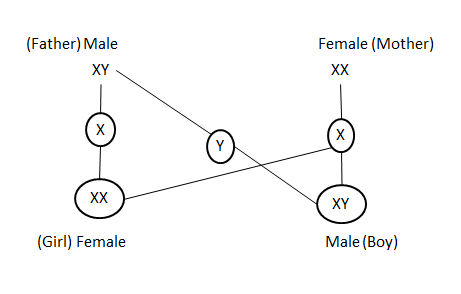
In a human being, the sex of a child is determined depending upon which type of male gamete fertilizes with the female gamete. There are 23 pairs of chromosomes in each of the mother and the father. Out of 23 pairs, 22 pairs are said to be autosomes and one pair is called sex chromosomes (in male XY and female XX). At the time of fertilization, the sperm fertilizes the egg cell to form the zygote. If the sperm carrying X- chromosome fertilizes an ovum carrying an X chromosome, then the child born will be a girl. If the sperm carrying Y- chromosome fertilizes an ovum carrying X- chromosome, the child born will be a boy.

seo images


DIFFERENCE BETWEEN DOMINANT AND RECESSIVE TRAITS


Question 1

If a trait A exists in 10% of a population of an asexually reproducing species and a trait B exists in 60% of the same population, which trait is likely to have arisen earlier?

Answer

Asexually reproducing species show very few variations which are seen usually due to mutation. Any such variation in an individual takes time to become considerable part of the population as it shows up only in individual's progeny. Therefore, if a trait A exists in 10% of a population of an asexually reproducing species, it must be a recent variation and if a trait B exists in 60% of the same population, it is likely to have arisen earlier.

Question 2

How does the creation of variations in a species promote survival?

Answer

Any species is adapted to survive in a particular niche. In case of any sudden change in that niche the species may not survive if all the individuals are alike. But if few individuals are different due to variations they can adapt to the changed conditions and thus species can avoid being wiped out. Therefore, the creation of variations in a species promote its evolution and hence its survival.

Intext Questions 2

Question 1

How do Mendel's experiments show that traits may be dominant or recessive?

Answer

Mendel used a number of contrasting visible characters of garden peas – round/wrinkled seeds, tall/short plants, white/violet flowers and so on. When he crossed plants with contrasting characters, there were no halfway characteristics in the first generation. For example, if a tall plant was crossed with a short plant, all plants were either tall or short and no plant was found with medium height. In F2 generation cross between two tall plants gave short plant as well. This proved that there are two contrasting characters out of which one is dominant which masks the effect of other which is recessive.

Question 2

How do Mendel's experiments show that traits are inherited independently?

Answer

Mendel crossed a tall pea plant with round seeds with a short pea plant with wrinkled seeds. The F1 progeny were all tall with round seeds. Thus, tallness and round seeds are the dominant traits.
Mendel then used F1 progeny to generate F2 progeny by self-pollination. He observed that some F2 progeny were tall plants with round seeds, and some were short plants with wrinkled seeds. However, he also found that some F2 progeny showed new combinations like tall but with wrinkled seeds, while others would be short but have round seeds. Thus, Mendel’s experiments showed that traits are inherited independently.

Question 3

A man with blood group A marries a woman with blood group O and their daughter has blood group O. Is this information enough to tell you which of the traits – blood group A or O – is dominant? Why or why not?

Answer

No, the given information is not sufficient to tell which of the traits is dominant because we don't know all possible blood groups of all the progeny.

The father's blood group is A, which means he can be homozygous (AA) or heterozygous (AO). Similarly, mother can also be homozygous or heterozygous.


Exercises

Question 1

A Mendelian experiment consisted of breeding tall pea plants bearing violet flowers with short pea plants bearing white flowers. The progeny all bore violet flowers, but almost half of them were short. This suggests that the genetic make-up of the tall parent can be depicted as

  1. TTWW
  2. TTww
  3. TtWW
  4. TtWw

Answer

TtWW

Reason — Possibility of genotype for parent plants:

  1. Tall pea plants bearing violet flowers — TTWw or TtWw or TTWW or TtWW
  2. Short pea plants bearing white flowers — ttww or ttWw

Since, the progeny all bore violet flowers, the tall parent must be homozygous for violet flower colour i.e. WW. Also, almost half of the progeny were short shows that the tall parent must be heterozygous for tallness i.e. Tt. Therefore, the genetic make-up of the tall parent can be depicted as TtWW.

Question 2

A study found that children with light-coloured eyes are likely to have parents with light-coloured eyes. On this basis, can we say anything about whether the light eye colour trait is dominant or recessive? Why or why not?

Answer

No, we cannot say anything about whether the light eye colour trait is dominant or recessive based on above given fact because:

  1. It is not clear whether parents are heterozygous or homozygous.
  2. It requires to study inheritance pattern upto three or more generations.

Question 3

Outline a project which aims to find the dominant coat colour in dogs.

Answer

Following are the steps that should be followed in order to find the dominant coat colour in dogs:

  1. Find the homozygous male for coat colour.
  2. Find the homozygous female for contrasting coat colour.
  3. Both are mated to get F1 generation.
  4. The colour of coat of progeny will be the dominant colour.

Question 4

How is the equal genetic contribution of male and female parents ensured in the progeny?

Answer

During gamete formation the cell divides by meiosis giving four haploid (n) cells. The normal number of chromosomes in human a cell is 46 i.e. 23 pairs. The gamete cells, therefore, formed after meiosis have 23 chromosomes each. When fertilization occurs, the male gamete and female gamete fuse together and the original number of chromosomes is restored. This means that the zygote has 46 (23+23) chromosomes — 23 from male gamete and 23 from female gamete. This is how the equal genetic


PERIODIC TEST 2 SCIENCE CLASS 10 PAPER with marking scheme.


PM SHRI KENDRIYA VIDYALAYA N.E.R BAREILLY

PERIODIC TEST – 2

SESSION – 2025-26

CLASS – 10th                               SUBJECT – SCIENCE

TIME – 11/2HRS                                                                                                  MM – 40

Q.No

Section A

Marks

1

Which of the following is a correct combination of function and part of the brain?

A. Posture and balance: Cerebrum

B. Salivation: Medulla in midbrain

C. Hunger: Pons in hindbrain

D. Blood pressure: Medulla in hindbrain

1

2

The blood glucose level in a patient was very high. It may be due to inadequate secretion of:

 A. growth hormone from pituitary gland

 B. oestrogen from ovary

C. insulin from pituitary gland

D. insulin from pancreas

1

3

Which of the following substances when dissolved in equal volume of water, will have the highest pH value?

A. Sulphuric acid              B. Acetic acid                   C. Magnesium hydroxide D. Sodium hydroxide

1

4

An electric iron of resistance 20 Ω draws a current of 5 A. The heat developed in the iron in 30 seconds is:-

a)15000J        b)6000J         c)1500J             d)3000j

1

5

The atomic no. of three elements X,Y& Z are 19 ,13 and 17 respectively.which of the following statement about these elements is correct?

A.X is a metal and it forms basic oxide.   

B.Y is a non metal and it forms acidic oxides    

C.Both Y and Z are non metals .

D. X is a non metal while Z is a metal.

1

6

There is a cerebellar dysfunction in a patient. Which of the following activities will get disturbed in this patient as a result of this?

A. Salivation.                                                      B. Hunger control.                                 C. Posture and balance                                        D. Regulation of B.P.

1

7

The oxide which can react with HCl as well KOH to give corresponding salt and water is.

A. CuO              B.Al2O3                        C.Na2O                              D.K2O.

1

8

The following question consists of two statements – Assertion (A) and Reason (R). Answer these questions by selecting the appropriate option given below: A. Both A and R are true, and R is the correct explanation of A. B. Both A and R are true, and R is not the correct explanation of A. C. A is true but R is false. D. A is false but R is true

Assertion-receptors are usually located in our sense organs and perceive a particular stimulus.

Reason- different sense organs have different receptors for detecting stimuli.

1


Section B


9

2

10

What are reflex actions. Draw a well labelled reflex arc.

2

11

2

12

Show the formation of             i) CaO                 ii)MgO

2


Section C


13

3

14

3


Section D


15

Oxygen can combine with both metals and non-metals. It combines with Calcium to form CaO and with carbon to form CO2.

(a) What type of bond is formed between carbon and oxygen?

(b) Identify the type of bond formed between Calcium and oxygen. (c) Which of the above compounds will be a good conductor of electricity in molten state and why?

(d) Comment on the physical state (solid, liquid or gas) of CaO and CO2.

 (e) What is the valency of carbon in CO2?

5

16

i)Define ohm’s law.

ii)Name and define the physical quantity defined by the slope of V-I Curve given in the diagram. Use this graph to find the value of this physical quantity in SI units.

iii)Establish relationship between 1kWh and 1 joule.

5


Section E


17

Mohan and Rohit observed that shoots of a plant growing in shade bend towards the sunlight. Whereas, leaves of ‘Touch me not’ plant fold and droop soon after touching. They were curious to know how these movements occur in plants

4

18

  The extraction of metals from their ores and refining them for the use is known as metallurgy. It Involves several steps such as concentration of ore into oxide through  calcination or roasting, reduction of oxides using suitable reducing agents and refining of metals.

i)Name an ore of mercury.

ii)write a chemical equation for the calcination of ZnCO3.

iii) write the difference between roasting and calcination.


2+2

                                                         MARKING SCHEME

 1.D.BLOOD PRESSURE :MEDULLA IN HIND BRAIN.

2.D.INSULIN FROM PANCREAS.

3.D.SODIUM HYDROXIDE.

4.R=20 OHM   I=5 A T=30 SEC H=I2RT      =5X5X20X30=15000J

5.A.X IS A METAL AND FORMS BASIC OXIDES.

6.C.POSTURE AND BALANCE.

7.B.AL2O3

8.A.ASSERTION AND REASON ARE TRUE AND R IS THE CORRECT EXPLANATION OF A.

9.A. The pin will drop but will take less time to drop because silver is a better conductor of heat than aluminium.

B. No, aluminium wire will not melt because metals have high melting points.

10.A reflex action is a quick, automatic, and involuntary response to a stimulus that occurs without conscious thought, often to protect the body from harm.


11.(i)𝑅= 𝑅1𝑅2 /𝑅1+𝑅2 = 8×8/8+8 =4 𝑜ℎ𝑚𝑠

(ii)𝐼= 𝑉/𝑅 =8/(4+4)=1 𝐴

12.


13.A.

(i) No, ‘X’ is highly reactive and will catch fire.

(ii) Sodium.

It is extracted from molten sodium chloride by electrolytic reduction

Cathode: Na+ + e- ---- Na

Anode: 2Cl-  Cl2 + 2e-

(Potassium is also a correct option)

OR

B.

(i) Copper gets oxidised/corroded to basic copper carbonate which is greenish in colour.

(ii) No, iron will rust and the reddish layer of rust will come off exposing iron to air, the dome will not be stable. Copper on the other hand on corrosion forms a protective layer which does not allow further corrosion.

(iii) Copper is a highly malleable metal, its thin sheets can be used to give different shapes of roofs, like the shape of a dome.

14.A.

(i) X = NaHCO3; Z = Na2CO3 (0.5+0.5)

(ii) Decomposition reaction (0.5)

(iii) Solution A (0.5)

(iv)Increasing order or H+ ions C<B<A (1)

OR

B.

(i) As bee sting is acidic and wasp sting is basic. (1)

(ii) To change the nature of soil to (neutral or basic). (1)

(iii) To protect sculptures from the effects of certain gases present in

environment and acid rain. (1)

15.(a) Covalent bond (b) Ionic bond (c) CaO, due to presence of free ions in molten state. (d) CaO is solid while CO2 is a gas. (e) 4

16.i) Ohm's Law is the law, which states that the electric current (I) flowing through a conductor is directly proportional to the voltage (V) applied across it and inversely proportional to the resistance (R) of the conductor. Mathematically, it can be represented as: (1) 

V=IR

ii.The slope of the VI curve indicates the resistance (R) in ohms (Ω), as per Ohm's Law which states that V = IR.

From the graph, select two points. For example, the point (0,0) and (0.8, 6) gives ΔV = 6 - 0 = 6 V and ΔI = 0.8 - 0 = 0.8 A

Calculate the slope: R = 6 V / 0.8 A = 7.5 Ω.

iii.) 1kWh=3,600,000 j

17.

A. ● Bending of shoots of plants is a response to the stimulus and a directional, growth-related movement. 

● When growing plants detect sunlight, a hormone called auxin, synthesized at shoot tip helps the cells to grow longer. 

● When light is coming from one side of the plant, auxin diffuses to the shady side of the shoot. 

● This concentration of auxin stimulates the cells of the shoot to grow 4 longer on the side of the shoot which is away from the light. Thus, plant appears to bend towards light. (0.5 x 4 =2) 

OR 

B. ● Leaves of ‘Touch me not’ plant respond to the stimulus by showing growth independent movement.

 ● These plants use electrical–chemical means to convey the information from cell to cell. 

 Movement happens at a point different from the point of touch. 

● Plant cells change shape by changing the amount of water in them, resulting in swelling or shrinking, and therefore in changing shape. (0.5 x 4 =2)

 C. Growth of pollen tubes towards the ovule is an example of chemotropism whereas bending of shoots towards sunlight is an example of phototropism. (1) 

D. i) Although both plants and animals show electrical–chemical means to convey the information from cell to cell but unlike nerve cells in animals there is no specialized tissue in plants for conduction of information. (0.5) 

ii) In animal cells, change in shape occurs because of the specialized proteins found in muscle cells; plant cells change shape by changing the amount of water in them. (0.5)

18.i cinnebar.

ii.Zinc carbonate is heated strongly in limited supply of air to convert it to oxide. This process is called calcination.

ZnCO3(s)Zinc oxideHeatZnO(s)Zinc oxide+CO2Carbon dioxide


iii.

ATOMS AND MOLECULES REVISON NOTES

  ATOMS AND MOLECULES What is an Atom? An atom is the smallest particle of an element. 📚 Dalton’s Atomic Theory -Jhon Dalton...